Belonging as Sense of Place: An Introduction to Placemaking
Places People Change explores neighborhood belonging through three lenses: social cohesion (our trust in neighbors), collective efficacy (our belief that we can shape our future together), and sense of place — our connection to the neighborhood itself. Over the next two episodes, we dig into that final piece, also known as place attachment: the emotional bond and sense of identity that ties people to a place's history, culture, and everyday rhythms. It's about belonging to the neighborhood itself, not just the neighbors in it.
Our guest, Ethan Kent, has spent 25 years building that kind of belonging through placemaking — a global, community-driven movement (born from the 1970s Project for Public Spaces) that designs parks, main streets, and public spaces around how people actually want to gather and connect. As executive director of PlacemakingX, which he founded in 2019, Ethan has worked in over a thousand cities across sixty-five countries and helped launch more than thirty regional placemaking networks. Listen in as we talk about designing places for belonging — and making our neighborhoods not just livable, but lovable.
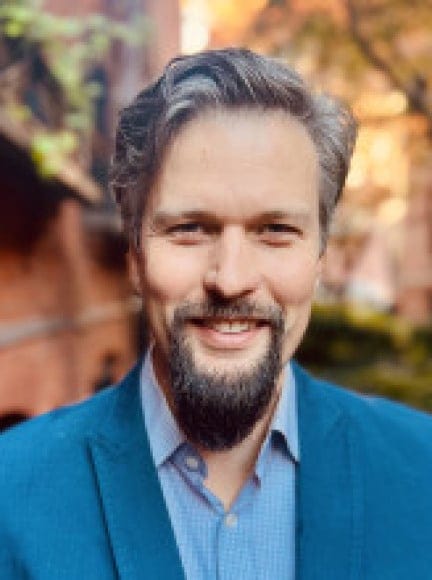
Ethan Kent works to support public space organizations, projects, and leadership around the world to build a global placemaking movement. Ethan has traveled to more than 1000 cities, in 65 countries, to advance the cause of leading urban development with inclusive public spaces and placemaking. In 2019 he co-founded PlacemakingX to network, amplify and accelerate placemaking leadership and impact globally. Ethan has helped initiate and grow 30+ regional placemaking networks covering much of the globe, while also supporting the PlacemakingUS network, and the Social Life Project.
He builds on more than 25 years of working on placemaking projects and campaigns with Project for Public Spaces. Ethan has been integral to the development of placemaking as a transformative approach to economic development, environmentalism, transportation planning, governance, resilience, social equity, design, placekeeping, digital space, inclusion, tourism and innovation.
Shawn Duncan: Ethan, thank you so much for being willing to join this conversation today. I'm excited to engage in this conversation around placemaking and place attachment — I value your perspective a lot.
Ethan Kent: Likewise. I value your perspective and your leadership in bringing so many amazing people together around this topic.
Shawn Duncan: As the executive director of PlacemakingX, you're constantly speaking, working, and engaging around how people influence their places and environments. But places also influence and shape us. I'm curious — for you personally, is there a place or neighborhood that has shaped you in a particular way, and how so?
Ethan Kent: I've been very lucky to grow up in New York City, and through my father, to travel around the world learning from people who are shaping places — getting to experience some of the most vibrant, inclusive public spaces around. I grew up in New York and saw the transformation of the city, both how it's seen locally and globally. I've been involved since the late '90s in many of those transformations, seeing how the story of a city can be shaped by advocates — people on the ground who are often first opposing something, then harnessing that sometimes-negative NIMBY energy into something creative: preserving what they love about a community by celebrating and creating more of what they love, and attracting people on their own terms.
Shawn Duncan: Growing up with a father who was instrumental in launching this work, this must have just felt normal to you. Going back to your childhood, was there a moment when it clicked — when you remember this coming alive for you?
Ethan Kent: There are many moments — it was really the people who love places and work to create them that inspired me and helped me see the excitement of this work. But my first real experience was at a conference in Venice with my father. I think it was 1985, I was eight or nine. It was the first time I was ever allowed to walk around a city by myself. It was an incredibly freeing experience — I had to wander ten or fifteen minutes from the hotel to the conference, and I remember the vibrancy of the streets, feeling so safe and comfortable, with no cars. And also the conviviality of the conference itself — it happened to be the first Making Cities Livable Conference. There have been about sixty of them since, alternating between Europe and the US. That one was memorable.
Shawn Duncan: For anyone listening who's heard the word "placemaking" but maybe didn't know it's an actual movement — an official set of practices happening around the world — how would you describe what's meant by placemaking?
Ethan Kent: It's an evolving term, and a fraught one. At its broadest, I see placemaking as the process of how people and places build each other up. It really started with the tools and processes we developed at Project for Public Spaces in the '90s, when I joined to put into practice the work of Jane Jacobs and William H. Whyte — our mentors. My father founded Project for Public Spaces in 1975, given free office space at Rockefeller Center, to apply Whyte's and Jacobs's ideas in public spaces. In the '90s, right around when I joined, we started developing principles and tools built on the idea that the community is the expert. We realized we could build much broader impact by helping to reveal and support the local expertise of the people who know their public spaces best. At the time, the biggest obstacle to placemaking was public participation and ownership — and honestly, we're still at a low point in local agency and participation in shaping the world beyond our own homes. So we see placemaking as supporting and challenging everyone to take responsibility for stewarding — and thinking bigger about how they can shape — the world beyond their front door.
Shawn Duncan: Is there a primary problem, or set of problems, that placemaking is trying to solve?
Ethan Kent: It's been evolving — pretty much every year I've been involved, we've taken on a different challenge, though we've never fully solved any of them in a year. Transportation planning has been one of the biggest obstacles: it's focused on moving people through places rather than to them, degrading the very destinations it's meant to serve. I could list fifty more — from silos in government to challenges in democracy-building and health. Many causes understand their problems and have solutions, but it's how we collaborate and organize around place that enables a more systemic ability to address those problems and actually apply the solutions.
Shawn Duncan: This isn't a shot at the experts and professionals who work on our cities — I value those people deeply. But is there a distinction between placemaking and disciplines like urban planning, urban design, or community development, which are also trying to make places better through design?
Ethan Kent: Good question. In many ways, placemaking emerged as a reaction to — and a disappointment with — those disciplines leading with their own solutions and expertise, which made them more distant from the people they're meant to serve. The progressive wings of those disciplines have real solutions we want applied faster than they are. But we think the lens and approach of those disciplines can actually undermine their own application, and ultimately the demand for their work. A place focus turns that process upside down — it builds the capacity and agency of communities to be better clients, to demand this work, and to look more holistically beyond the silos of individual solutions. So we consider the progressive wing of many disciplines some of our best friends — their knowledge is incredible — but we'd say their work is, at best, place-sensitive. Given how urgently we need to respond to health, equity, and environmental challenges, that paradigm isn't getting applied fast enough. We talk about being "place-led" as the paradigm shift: building the capacity of communities to lead, to collaborate, to drive demand — with place as the actual goal. No single discipline's job is to create great places. Better urban design, better streets, better health, better governance alone don't add up to that goal. As your podcast title suggests, place is this missing thing — it's what we live to experience, to create, to realize our individual and collective potential through. And right now, it's nobody's focus. There's a gap between all of it.
Shawn Duncan: You have global experience with people working on places. Are there other contexts or cultures where place is a more obvious actor in how people think about the world? In the US, we tend to hover above places or move through them — we don't really see place as its own actor shaping life. Do different cultures engage with the idea of place differently?
Ethan Kent: For sure. Part of the reason we started PlacemakingX was to network this conversation globally, because every part of the world is leading on place from a different strength, sector, culture, or discipline. But whoever's leading it can also end up dominating and blocking others — so by networking globally, we balance each other out. There's infinite learning, and every part of the world has something to teach. We also want to network globally because a lot of the world is copying America's worst mistakes around transportation, architecture, and buildings. Some cultures can leapfrog past those mistakes because they're more traditional, and frankly, indigenous cultures are much more deeply connected to place. I've worked with the Māori in New Zealand quite a bit, and they say we don't just need indigenous placemaking or for indigenous people to be respected — all placemaking needs to become more indigenous, more compatible with indigenous ways of relating to place. Western, top-down culture isn't especially healthy for any of us in this respect, and we're often imposing place models that don't fit. Every part of the world has something to teach — more informal cultures and lower-income parts of the world have a lot to teach, even as we're honest about the real challenges they face. Meanwhile, we're learning how to reinvent government from parts of the world advancing very technical aspects of placemaking. In the UK, for instance, the placemaking conversation can be too top-down and expert-led, but there's incredible sophistication in their research and analysis — we started a network there to help diversify who's involved in that conversation and share that expertise globally.
Shawn Duncan: I recently read about an indigenous population that doesn't use "right" or "left" — they use cardinal directions, facing south or west. It struck me how attuned that is to place as your orientation to the world — there's a wiring for that which isn't necessarily fundamental to how I was nurtured to encounter the world.
Ethan Kent: That's a good point, for sure.
Shawn Duncan: If we design our cities for cars, we get more cars — and all the impacts that come with that. Placemaking, I assume, is trying to put the human being at the center of design instead. But what does that actually mean — to design around the human rather than the car, or business, or commerce? What does it look like to design and shape places with the human at the center?
Ethan Kent: It started as human-sensitive, human-centered design, and there's still an infinite amount to learn there. But we've come to see it as iterative — it takes people to create a place, and a place to create connections between people and community. It's a building-up process. We have to be careful that "place-sensitive" doesn't just mean designers being sensitive to humans while still not getting their solutions applied, or in demand, fast enough. If we plan for cars and traffic, we get cars and traffic. If we plan for people and places, we get people and places. But really, it's about how we challenge and empower people to take responsibility — not just be consumers of the built environment, but co-creators of it, building their own agency. That's why we talk about moving the paradigm from livability — which frankly correlates with high cost of living and negative cultural and economic gentrification, and a monoculture around the world — to leading with lovability and place attachment. Ironically, that actually helps achieve livability more quickly, more affordably, and more inclusively.
Shawn Duncan: That's a distinction worth teasing out. Even here in metro Atlanta, I've noticed some suburban communities doing a better job of designing for walkability and social districts — less sprawl. There's a difference between when that feels like a commodity versus when it feels like real placemaking. How would you articulate the difference between livability as a commodity to attract people, versus something else we're aiming for?
Ethan Kent: The market is strong, and we have to work with markets. In some ways, the demand in suburban areas has surprised us — there's real pent-up demand for good places there, and some developers and private-sector folks are noticing. That's part of why we've started working more with the federal government — through the New York Fed's Flourishing Neighborhoods program, we're building out an additional design team around what we call "place-led development," which tries to attract private-sector investment in place while growing returns. We want the shared value to rise exponentially, and the private value to rise enough to keep driving investment. But place-led development truly leads with the place and the people already there — something public, on a spectrum from public to private, formal to informal. Anchoring new investment that way disrupts the dominant development paradigm you see most clearly in the suburbs: high private value, very little shared value. There's broad agreement that corporate capitalism's "place-taking" culture isn't working, even though we're addicted to it. We're not against it — we're trying to prove that "place capitalism," leading with the shared value of place, is ultimately what drives and sustains investment and builds market resilience, environmentally and socially. As people become freer to move and invest where they like, the places that succeed most will be the ones people love — and more importantly, the ones that let people love them and invite them to contribute.
Shawn Duncan: I love that contrast between livability and lovability. What does it mean to love your place rather than see it as just a commodity or amenity? I'm not against amenities — neighborhoods should have them. But even in how people talk about choosing where to live, it can sound a lot like shopping for a car or a piece of clothing, rather than being invited to actually love a place and be invested in it — that cycle of mutual benefit that is place attachment. In your own words — what is place attachment, and why does it matter?
Ethan Kent: It's about not just consuming a place, but actually feeling attached to it. People talk about resilience as building resilient infrastructure — but no matter how much infrastructure you build, if people don't love the place and want to be there, it isn't actually resilient. People can now choose to live and invest where they like more than ever — whether you're a tourist or a resident, you develop a sense of attachment. Relationships to place are a fundamental building block of civilization — the neurons, the mycelium that build consciousness and resilience. That's how we first started to settle and build civilization: through place attachment. It can be very functional, but a more evolved civilization also has wisdom, art, and creativity that emerge from that connection. Cultural innovation has always emerged from deep connections between people and place — but almost none of our efforts focus on that. A lot of innovation districts we've studied are missing that element: they're building people near each other without any place attachment, so investments in human and intellectual capital tend to leave, because there was never any attachment to the place itself.
Shawn Duncan: I wrestle with this — I'm someone who's advocated for a strong sense of place and identity, and I love branding, logos, and fonts. But there's an edge where it starts to feel like a branding effort for commercial appeal versus a natural outgrowth of real place attachment and collective identity.
Ethan Kent: For sure. Branding does sit a bit cheap sometimes, but it's also genuinely powerful — places do have brands, whether we like it or not, and that is their identity. The stronger, more authentic brand is the one that emerges organically from the community, out of a real process — not something stamped on afterward, like declaring "this is the arts district."
Shawn Duncan: I come out of the neighborhood-revitalization world, where cities, nonprofits, and philanthropy are trying to reverse historic disinvestment and racialized policy in disadvantaged neighborhoods, and invest deeply to restore opportunity and wellbeing. In those conversations, safety, income, employment, education, and affordable housing come up constantly — but it's rare that "Do people here love their neighborhood? Do they have a sense of place or place attachment?" is a lead topic. How would you advocate that place attachment has to be a lead concern in that work — not just an afterthought to housing or economics?
Ethan Kent: A lot of even the most progressive solutions, if they aren't respecting and building local capacity and expertise, can end up degrading it — even the right solutions, if they aren't adapted with people, need an element that builds and supports people's connection to each other and to place. That's a virtuous cycle, and it's the real transformation story. Too much investment and development follows a linear, input-output growth model, when we actually need transformation — stories of how people come together, because stories are what culture is built on, and culture is the most authentic and fastest kind of change. Culture is what a lot of racialized and lower-income groups can connect to and create — you see it in New York, where the best art and culture has often come out of the most challenged parts of the city, out of hardship, connection, and creativity, whether that's blues, R&B, or any number of other traditions.
Shawn Duncan: What strikes me is the dynamic of agency — even if all the right domains around housing or economics are being addressed, if the work is done for people, on people, or around people, but doesn't include them, real harm still happens. Our colleague David Erickson, in his book on the "fifth freedom," writes about hope — this sense that "I believe I'm affecting the direction of my place, and I'm hopeful about that." Even though that can feel too subjective to some, people are actually studying it: when people possess that sense of hopefulness and agency in their place, it has real benefits — for their own health, and for the economy of the neighborhood itself.
Ethan Kent: For sure. And you mention housing — that's the biggest issue right now, the biggest shift happening in politics and across many fields. I think housing affordability has been, and still is, a big blind spot for placemaking. But I'd also say housing's biggest blind spot is placemaking. We're building housing units, housing projects, that are disconnected from place attachment, from local economies and culture — often actively degrading them. Our work emerged out of the '60s and '70s, a period when a lot of mistakes were made destroying neighborhood fabric with housing projects that don't work. I'm afraid we're repeating some of those same mistakes. It shouldn't be either/or — it should be "yes, and." Investing in place drives viability and demand for investment in housing, and vice versa.
Shawn Duncan: I've noticed that unspoken philosophy in some affordable housing work — it doesn't feel very human. It's almost like we're parking cars in a garage: we just need a shelter to put a human body into. Even when the work is driven by justice and equity and all the right values, the end product often doesn't feel designed for human beings meant to live in community with other people.
Ethan Kent: Yeah — we're creating houses and space, not homes and places. It's a mechanistic worldview instead of a human one.
Shawn Duncan: That mechanistic framing resonates. We've talked before about the Knight Foundation's "Soul of the Community" study, which looked at what makes people love where they live. From your experience, what are the things, expected or unexpected, that spark a deeper sense of "I love my place"?
Ethan Kent: That study is old now, but it really opened our eyes. Going in, the assumption was that things like parks, jobs, and schools would drive that love — the consumptive model. But there was very little correlation with those things, and a high correlation with places that were welcoming, had opportunities for social engagement, and had good aesthetics — though aesthetics alone didn't create attachment. I think about it like attachment to a person: you feel welcome to talk with them, you enjoy engaging with them socially — maybe aesthetics play a small part, but on their own, they don't create deeper connection. It's the same with place. Studies show that markets, playgrounds, and beaches are places where people are most comfortable being around people who are different from them — but diversity alone isn't equity. You need diversity along with interaction and equality for diversity to become a real value. A good ecosystem, a good community, needs diversity, equality, and interaction together — investing in all three, because any one alone is nearly valueless. Diversity without connection is a missed opportunity, even if it's not worse than outright division. What makes people love a place isn't just consuming it — it's feeling like they're contributing to it. We see this clearly in tourism: tourists don't just want to check a place off a list, they want to feel like they had a real interaction, that they gave something as well as took something. Placemaking, at its best, is a process for giving everyone — locals, tourists, investors — the opportunity and mechanism to contribute to a place's culture, economy, and identity.
Shawn Duncan: One thing that study raised was "place optimism" — feeling hopeful about the future of where you live — and it's interesting that this doesn't necessarily track with measurable stats about how safe, wealthy, or healthy a neighborhood actually is. You can be in a statistically "healthy" neighborhood with little optimism about the future, or in a place that looks disadvantaged from the outside where residents feel real optimism. What sparks that sense of place optimism, regardless of what the data says?
Ethan Kent: I think it speaks to people wanting to be part of a story — to see themselves as part of an evolution, a continuum, a movement. That really sparks people's relationship to place, and that's transformation. Detroit is the city we've worked in the most over the past thirty-plus years. It's not as livable as a lot of other cities, and there's real tension there — but there's also learning, creativity, and action between longtime residents and newcomers, alongside new investment. Overall, there's a sense that people want to be contributing to that story — that they're invited to be part of its innovative culture, economy, and social community.
Shawn Duncan: Placemaking isn't a top-down or outsider-driven movement, even though it values institutional and systemic partnerships that help initiatives take off. It's meant to be about the people of a place exercising their own imagination for their future, together. Is there a story that comes to mind — where people with very little power or resources came together and, through their collective power, shaped their place into something that deeply mattered to them?
Ethan Kent: Looking at great transformations around the world, they often trace back to one person — a facilitative leader people often don't recognize as the source of the idea. Sometimes it's an activist, sometimes someone in government, even a mayor. I'll give an example: a small plaza in Portland, Maine was failing, taken over by homeless residents, not really serving the community. The mayor wanted to sell it to an outside investor to turn it into event space connected to a hotel. That plan galvanized the community against it — but at first, all they had was opposition. They were brought together by one "zealous nut" — just a passionate neighbor. Collectively, they started to figure out what they actually wanted, tried things, started seeding ideas. It brought together the Occupy movement, Green Party folks, business leaders, and the museum across the street — all these unlikely partners. More than a decade later, they're still collectively programming that space, and with very little investment it's become a center of meaning, community, and attachment for Portland. That happened around the same time as Gezi Park in Istanbul and the Arab Spring — people around the world taking back public space. There's a lot of fear right now around NIMBYs and people resisting change, but there are also people who genuinely care about place and just need the opportunity — and sometimes the challenge and support — to say what they want. There's a real response to placemaking sometimes called "placekeeping." It means different things in different places, but often the best way to prevent your neighborhood from changing for the worse — especially for marginalized cultures and communities — is to proactively make it better yourself: to attract people and investment on your own terms, with your own values, rather than being afraid of placemaking.
Shawn Duncan: That proactive piece is what I'm curious about. You mentioned earlier a kind of passivity — across every income level — where people assume that what a place becomes is the domain of the city or developers, someone else's responsibility. The only time people activate is when they're afraid something bad is about to happen. As residents and neighbors, we have the capacity, power, and responsibility to proactively shape our own spaces, not just react to threats. How does that shift happen in people's minds?
Ethan Kent: Some places need a bit of a crisis. My board chair was CEO of several Australian cities that rank as very livable but actually lack a crisis — and he says government works most effectively during a crisis, and that's true of place attachment too: it becomes most holistic, efficient, self-organized, and emergent under pressure.
Ethan Kent: He believes we need to reorganize government to model that — every department needs to be about place, from policing to health to tourism to economic development. Everyone's goal should be building what we call "place capital," the shared value of the public realm — which enables both collaboration and resourcefulness. The next step is devolving some of that power to communities. Every part of the world is learning how to reorganize governance, democracy, and participation around the scale of place — community, neighborhood, district — which is really the human scale of civilization. Right now, nationalistic government and media absorb all the attention, creating a vacuum, but at the human scale of civilization, we're actually doing better than we have been. That's where most of our needs are actually met, even as the vacuum and toxicity at the national level feel worse than ever. We have to use that as an opportunity to reinvent and reconnect how we organize at the human scale globally, and to network that learning, advocacy, and mutual support. How we organize governance, financing, and development at a place-led scale is, we think, the future of civilization. As that happens, the boundaries and toxic media landscapes will start to fade, and we'll get to celebrate the huge impact people and place can have together — and we need that impact urgently. There's a real race right now to build place attachment and strong communities, because those are the places that will succeed. Frankly, low-income and rural communities are often better positioned to do that than a lot of the high-end, expensive, consumptive neighborhoods dominating urbanization today — though we still need walkable, affordable urbanism, since we've destroyed so much of it. Part of the affordability crisis is a lack of that. Main streets are really the foundation — that's where volunteerism and self-organization have historically worked in America, and they're the building block of strong civilizations: main streets, markets, squares, waterfronts — that's where place attachment is strongest. Investing at that main-street scale, at scale, is what will save civilizations.
Shawn Duncan: It's fascinating how this is both deeply economic and pragmatic, and also not about commodification — because if we do it well, a place becomes more economically vibrant, public health improves, and all the indicators we track for healthy cities and neighborhoods go up. We've just gotten the order backwards, leading with commodity thinking instead of human connection. I'm encouraged that here in Atlanta, our colleague David Edwards is working in the mayor's office trying to organize departments around neighborhood as the driving frame, rather than siloed departments like police or education — letting the localized place be the driving thing. That, scaling up to societal or global health, feels hopeful to me.
Ethan Kent: That's definitely the future, and there's infinite learning in how we all work together to get there. We want to network that learning, because the people closest to a community know it best — but they need to be connected to others around the world who've faced similar challenges. It's remarkable how quickly we've been able to connect people working on place globally, because they're all so passionate about it — they may have nothing else in common, but they connect immediately because they have so much to teach each other. I'm lucky to have grown up around this and met so many people with so much to teach. The limiting factor isn't the problems or the solutions — it's networking the collective learning, advocacy, and action, and the collective story of people doing this work.
Shawn Duncan: Thank you a thousand times for this conversation — but more than that, thank you for what you do every day. Honestly, I struggle to feel hopeful when I look at the national landscape; every time I check the news on my phone, I think, "What's coming next?" But when I connect with you, when I look at what placemaking is doing, when I scroll through the hundreds of communities on your website, it's like a fresh breeze — there are so many beautiful people out there doing beautiful things. I want my sense of reality anchored in that, not so I ignore the harder stuff, but so I can go toward that harder stuff from a place of hope.
Ethan Kent: Right — and it's a much more authentic power than the narratives of power, which are really just narratives. The toxic nationalism and monoculture we see around the world is actually more fragile than people's connection to place. I don't know exactly how it will unfold, but it's a small world right now — we're all connected. Our PlacemakingUS network recently published an article with some Persian placemaking colleagues about everyday life around place in Iran. At that scale, you realize we're not that different — life goes on, and we don't want to see people only through the lens of war or conflict. We have a strong Arab placemaking network too. At the human scale, it's amazing how many differences get bridged — people are all problem-solvers at that level.
Shawn Duncan: Thank you so much for this. If people want to get more involved, learn more, or connect with others doing this work, where should they go?
Ethan Kent: In most cities and towns, there are people doing placemaking. You can go to our website, sign up as an advocate, and search for any town to connect with other local advocates — there are national and regional networks, including PlacemakingUS, a Canada network, and others covering most corners of the world. There are conferences too — Project for Public Spaces is running Placemaking Week in Detroit in late June, which I'll be at, along with a lot of others. We also run a lot of online webinars and discussions. Placemaking people are bridgers of different worlds and populations, so we welcome people from every discipline, sector, and background — that's really what we need: people who can bridge worlds. Conversations like this are genuinely valuable, and I'd invite everyone to help lead this conversation, whatever world they're coming from. We're here to support that.
Shawn Duncan: Ethan, thank you so much for who you are, for the influence you're having in the world, for what you represent and embody. Thank you for your time today.
Ethan Kent: Thank you, Shawn — really, really fun to talk with you.